
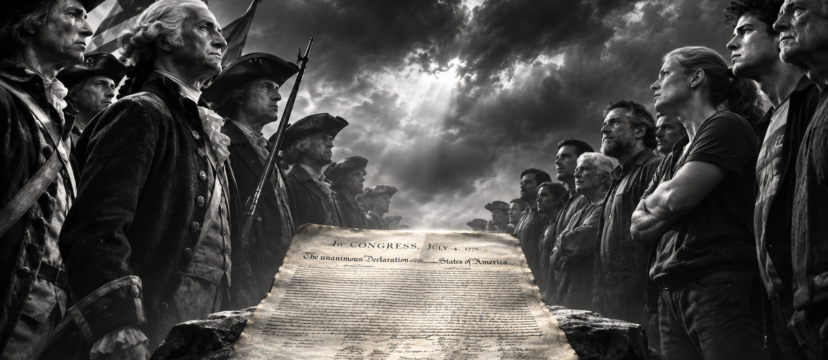
Daniel McCarthy, writing in Imprimis in November 2026 on “The Fight Over America’s Public History,” is an interesting read—with one exception: his premise is not entirely correct. His first sentence is powerful: “The American people can never forget the Revolutionary War and the Declaration of Independence—for the simple reason that if they ever do forget, they will no longer be Americans.” He ties memory of the Revolutionary War and Declaration to being an American. Which it is.
However, memory is fleeting. There is no one alive who remembers that war (as he points out). The only way to remember it is through what has been passed down to us.
His main error is in his second sentence, which throws off his entire thesis: “As individuals, we are not entirely defined by our personal histories.”
But of course we are defined by just that. What else is there to define the individual? Actions, thoughts, everything stems from your personal history. Every decision grows out of the decisions and experiences that came before it. Decisions compound. It is the shape of your character that helps define you to people.
And therein lies the challenge: our personal histories, comprised of memories, have lost much of their reference to the Revolutionary War and why it was fought. Without a memory, or a reference point, it ceases to exist in our understanding.
Color Blindness
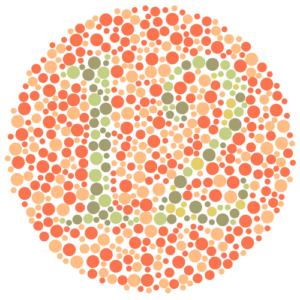
I’m color blind. I don’t see the number in this circle. But I remember there is a number from my memory of these tests which I failed. So my memory works with me to recall there is something there.
Another example came from a question I asked a intern once: “Does the man on the left look like Robert Redford?” The question was about a poster hanging in my office that I blogged about.
“I don’t know who Robert Redford is,” she meekly admitted. “He’s a movie star,” I helped. “I never saw any of his pictures,” she said, eyes cast down. (Subsequently she Googled him on her iphone, which she carried with her at all times, and found out who he was before going home that day.)
Imagine the number or the man in the poster is the Declaration of Independence and history of the Revolutionary War. I don’t see it because I didn’t live it (experience creates memories). She didn’t see it because she doesn’t know Robert Redford.
So she and I have to read about these things or ask someone to tell us about them. But the original Declaration is still there to read, isn’t it? Not once. Not twice. Multiple times because experience is the great teacher—way more powerful than reading words on paper. By the way, that is what makes classical literature so powerful: it is language charged with meaning, something to experience actually.
As is the Declaration of Independence. Which is why McCarthy’s essay is actually a call to arms, even though his premises are slightly jagged. His supporting paragraph is the tell in the unevenness: We can change. So can nations. But just as no one would discard his or her personal history—memories of family and friends, of love nurtured and adversity overcome—for anything less than the most dire of reasons, a nation cannot erase or tamper with its own history unless it has decided to become something else: a new country, unattached to its old founding principles and formative experiences.
People really don’t change. At least their core doesn’t. I mean, people can try to change, but the bottom line is we are who we are, who we have become through our experiences in life. Experiences alter character. But even the decision to change grows out of what came before. In the end, we are constantly at war with ourselves to become something we think we need to be, or to combat the wrath within all of us. We are, all said and done, animals.
Which makes the Declaration of Independence so unique: it was written by rational men seeking to state rationally what they were feeling passionately. Unfortunately, they had to back up their words with actions: the Revolutionary War. Reason put the argument on paper. Passion drove them to fight for it.
That’s really the problem, isn’t it? Words, that is. Words are great at trying to represent reality, but as they say, actions speak louder than words. So when words don’t work, people tend to take action. Worse, they take action without understanding the words, in which case they are anarchists.
McCarthy notes that, “A man would only give up his personal past if he believed it was irredeemably wicked and that he must become a wholly new man to be a good man.” Which is another problem: it’s impossible to do that, isn’t it? You can deny you are wicked, were wicked, or will be wicked if you are, in fact, wicked. And as the saying goes, “sin lies at the door.”
Without getting into a debate about what “sin” is or is not, an individual really can’t deny his or her past; it is part of our psychological development. As they say, you just can’t shake it off.
One of McCarthy’s main arguments – that dreamers “have imagined that our nature could be perfected through the use of government unshackled from the limits imposed by the Constitution” – is supported nicely, and also includes his correct conclusion: “We, as a people, wouldn’t always know the feeling of the Revolution, but we could remember its rational and moral cause.”
In other words, the passion for freedom is very different than the rational approach to freedom. Today, it’s the passion that is lacking because the rational has faded away.
Where Does Passion Come From?
Michael Crichton, in STATE OF FEAR, wrote: “If someone tries to kill you, you do not have the option of averting your eyes or changing the subject. You are forced to deal with that person’s behavior. The experience is, in the end, a loss of certain illusions. The world is not how you want it to be. The world is how it is.”
Passion will beat Reason. Emotion will defeat Logic. Dostoevsky said, “Sometimes it’s just nice to break things.” McCarthy’s ending two questions are the essence of his call to action: “Do Americans still wish to be the nation that was founded in 1776? Or do they wish to be a new nation founded on principles entirely different from those of the Declaration of Independence and the Constitution?”
Bullseye. The problem is that most people can’t decide because the memories of what happened back then have been slowly erased from our memory. Without that reference point, we become rudderless, rising to the first cry for “something different.” The shiny new object.
Thoreau’s Civil Disobedience saw this, and maybe that’s when it all started. In it he wrote:“Seen from a lower point of view, the Constitution[U.S.], with all its faults, is very good; the law and the courts are very respectable; even this State and this American government are, in many respects, very admirable, and rare things, to be thankful for, such as a great many have described them; seen from a higher still, and the highest, who shall say what they are, or that they are worth looking at or thinking of at all?”
But then he goes on: “However, the government does not concern me much, and I shall bestow the fewest possible thoughts on it. It is not many moments that I live under a government, even in this world. If a man is thought-free, fancy-free, imagination-free, that which is not never for a long time appearing to be to him, unwise rulers or reformers cannot fatally interrupt him.”
In fact, he wrote: “government is best which governs not at all.” Thoreau, as it turns out, was advocating anarchy. Because how can you live without a government? We have to have laws or truly we become beasts.
But when we lose the memory of the Declaration and the War fought to defend it, we’re talking about the use of words to convey intangible concepts, like freedom. Like the Revolutionary War. However, it is important to note that the Declaration of Independence is tangible: it is a document with words on it. The war that brought it to life—unless both are embedded in your memory—becomes the intangible. And that quality is what causes most of the problems, especially if you define the concepts differently.
In the age of social media and now AI, words speak louder than actions. And words are the most imperfect representation of reality, aren’t they?
But words are all we have outside of actions. So it is important to read and understand words—to read and understand what those words mean, should mean, do mean. And why, in the end, our founders had to back up their words with actions.
Anyone who reads the Declaration today probably doesn’t understand all of those words and certainly the concepts behind them without study. Why? Because not only do meanings of words change. The ideas these words are trying to convey have been lost in our memories. Time distorts things.
Here is an example from the first sentence of the Declaration.
The unanimous Declaration of the thirteen united States of America, When in the Course of human events, it becomes necessary for one people to dissolve the political bands which have connected them with another, and to assume among the powers of the earth, the separate and equal station to which the Laws of Nature and of Nature’s God entitle them, a decent respect to the opinions of mankind requires that they should declare the causes which impel them to the separation.
Our founders wrote long sentences, and untangling them rather than reading bullet points takes effort and study, something else that people don’t like to do these days.
But read them slowly. The word “unanimous” should stand out, and you know the meaning of unanimous don’t you?
The sentence is actually a statement that they are going to declare what is causing them to dissolve the “political bands” that have connected them “with another.” How many know what a political band means? How many people believe there are Laws of Nature, or Nature’s God entitling people to something? The rest of the document outlines the causes. But the ending drives the points home and is one of the most powerful statements ever made on paper:
We, therefore, the Representatives of the united States of America, in General Congress, Assembled, appealing to the Supreme Judge of the world for the rectitude of our intentions, do, in the Name, and by Authority of the good People of these Colonies, solemnly publish and declare, That these United Colonies are, and of Right ought to be Free and Independent States; that they are Absolved from all Allegiance to the British Crown, and that all political connection between them and the State of Great Britain, is and ought to be totally dissolved; and that as Free and Independent States, they have full Power to levy War, conclude Peace, contract Alliances, establish Commerce, and to do all other Acts and Things which Independent States may of right do. And for the support of this Declaration, with a firm reliance on the protection of divine Providence, we mutually pledge to each other our Lives, our Fortunes and our sacred Honor.
That’s one big sentence, isn’t it? And it takes a lot of effort to connect the thoughts in that one long sentence, doesn’t it? But there are keys to the passion these men felt about the “political bands” mentioned in the first sentence. You see a key word “War,” which they now believe they have the right to levy…and they are giving themselves the “powers” of a new government. But the real key is their oath: we mutually pledge to each other our Lives, our Fortunes and our sacred Honor.
They are putting more than their money where their mouths are.
The rest is history – and it is a history that is the memory we have lost.
Memory
People take pills for retaining memory. But in reality, retaining memory requires repetition and reinforcement. Without those, nothing will last, don’t you agree? You keep photos of moments. You keep video of moments. In the days before books it was oral tradition.
One of the most important functions of memory is to guide us in our actions. We don’t drive too fast because we remember we can cause an accident if we lose control. We don’t say the wrong thing at the wrong time because we remember it can cause a heated argument. Or we do it anyway, despite our memory.
But everything about memory is that it guides our actions; therefore, without memory, we are actually handicapped, aren’t we?
Besides, everything in life is about actions, not just words. And, you take actions based on your understanding of the words you read, the memories you have. Every decision as a result boils down to a “yes” or a “no.” A “1” or a “0.” Go, or stay. I used to argue with an employee who insisted there are grey areas in decisions. I told her grey is an illusion. Decisions are really Black or White. To be or Not to Be.
The famous philosopher Kierkegaard once wrote: “Passion is the real thing, the real measure of man’s power. And the age in which we live is wretched because it is without passion.”
You see the passion today and where it resides, don’t you? It is in entire movements designed to do one thing: put doubt in our minds about the value of the thoughts in the Declaration of Independence.
Doubting in itself is never a bad thing. When you doubt, you are forced to bring up arguments to overcome those doubts. Some people say doubt actually helps reinforce what you believe. But eventually, words won’t cut it; like the King rejecting the Declaration, it’s going to come down to a fight, which is the actual title of McCarthy’s essay. And it is a fight around a word he eventually introduces: morality. He said: “We, as a people, wouldn’t always know the feeling of the Revolution, but we could remember its rational and moral cause.” Morality requires a judgment of good and evil. Right and Wrong.
And that is the essence of what is happening around us today, as he said: judging whether the Declaration of Independence is right or wrong. But without memory of why it happened or the consequences around it, any judgment about it being right or wrong becomes flawed.
The King of England didn’t believe the words in the Declaration. So, the founders had to back up their words with war. A fight.
You can question the morality of the founders’ decisions all you want. However, the end result of those decisions brought us to this point in our history. What we are missing are the memories of that journey. We are at a point of a yes or a no. But unfortunately, actions are going to have to make the final decision which way we swing. My genuine hope is that when the actions arrive, at the very least we would have tried to remember what those founders said and did to bring us to this point of decision.