
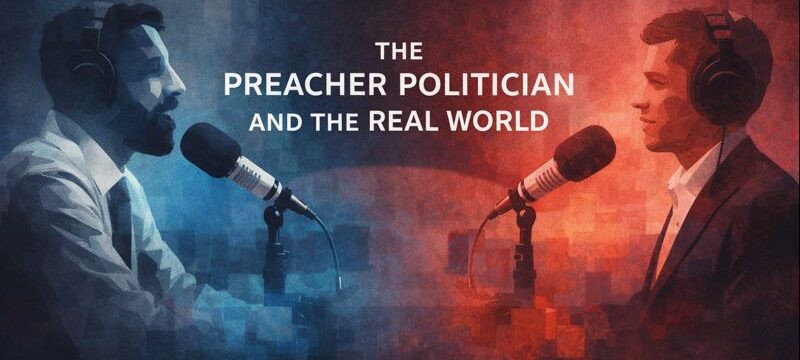
I never heard of State Representative James Talarico of Texas. Nor did I ever hear of Ezra Klein, host of the podcast “The Ezra Klein Show.” But when a friend sent me the following message, I had to find out more about these people. My friend said:
“I don’t know if you listen to Ezra Klein ever, but this week’s episode made me think of you. I think you might enjoy it: https://www.nytimes.com/2026/01/13/opinion/ezra-klein-podcast-james-talarico.html (if you can’t use that link just look for Ezra Klein in your podcast app and look for the one with James Talarico.) This is a view of Christ and Christianity I can really get behind.”
My friend is an atheist. I’m not.
So when an atheist tells me something has a view of “Christ and Christianity” she can really get behind, and that she thought of me when she listened to it, I become all ears. And eyes.
The Klein podcast is long — about an hour and a half. When you listen, you also find out that Talarico was interviewed by Joe Rogan, which is even longer: two and a half hours.
When you listen to both, you can understand why my friend’s attention was caught by Talarico’s philosophy: he is an excellent speaker. He believes what he says. He’s knowledgeable. Caring. And yes — persuasive.
I immediately understood why my friend liked him. And perhaps why he reminded her of me (not that I am everything Talarico is).
Talarico is a Democrat, as she is. But unlike my friend, he believes in Jesus. He really cares about everyone through the teachings of Jesus — as he interprets Jesus. My friend really cares about people too, but she doesn’t use Jesus to do that. She just does.
Talarico’s gift seems to be that he can bridge gaps — not the deep divides in our country exactly, but the divide between secular and religious. Or so it seems.
I was impressed.
But as my friend will tell you, I like to examine words carefully. Words are important because they are the things we use to describe reality. Aristotle said that if we don’t define the words we are using and come to some agreement, communication just isn’t possible.
It’s hard.
Maybe that’s why when my friend said, “This is a view of Christ and Christianity I can really get behind,” I became intrigued and decided to study what Talarico is really saying.
When I did that, I was still impressed — but not really.
Because Talarico is persuasive for a reason: he speaks like a preacher — but governs like a politician. And those are not the same role. A preacher can speak in moral absolutes. A politician has to define terms, accept consequences, and still live in the real world.
That difference matters more than most people realize.
Reality Fundamentals
With any experienced speaker like Talarico, listening to what is being said is often addictive. Sharp, single sentences come out and stop you in your tracks.
Even his actions juxtapose his theology and make you take notice: he voted against putting the Ten Commandments in every classroom.
So as with everything else when we examine words carefully, there are always deeper meanings behind the words — the connotations and denotations the words carry with them. Over time, people gloss over root meanings because time has that effect: time levels meanings, distorts meanings, and then we think what we are hearing is what we ourselves have defined and not what is being really said.
That’s why I have always found it worthwhile to “erase my blackboard” when it comes to judging what a person is saying. John Locke taught me that: people tend to put things on our blackboards that we think are our beliefs, but turn out to be something else entirely — something we absorbed, inherited, or repeated without realizing it.
And there’s another modern problem.
One of the most effective tricks in public persuasion is the adjective — because adjectives let you moralize without defining the word you are modifying. “Economic justice.” “Christian nationalism.” “Politics of love.” These are not definitions. These are recruiting tools. The adjective does the persuasive work while the noun stays conveniently undefined.
So the first task is not to agree or disagree with Talarico. The first task is to understand what he means — and what he avoids meaning.
I’d like to share with you some of what I learned in the study of this young, remarkable man.
Follow the Money
Here is what Talarico said about why he voted against the Ten Commandment bill (besides his advocacy for keeping church and state separate):
“I’ve fought the bill to require the Ten Commandments to be posted in every classroom. And I’ve often wondered, instead of posting the Ten Commandments in every classroom, why don’t they post “Money is the root of all evil” in every boardroom? Why don’t they post “Do not judge” in every courtroom? Why don’t they post “Turn the other cheek” in the halls of the Pentagon? Or “It’s easier for a camel to pass through the eye of a needle than for a rich man to get into the kingdom of heaven” on the floor of the New York Stock Exchange? This is the inconsistency I’m trying to call out, because they’re using my tradition — they’re speaking for me — and so I think I have a special moral responsibility to combat Christian nationalism wherever I see it.”
There are a few things in this statement I want to call your attention to.
First: If you are against posting the Ten Commandments in a classroom, you would naturally be against posting anything like the above in boardrooms, courtrooms, or anywhere else. The separation of church and state should be timeless and absolute.
But it sounds great when he says it, doesn’t it?
Second: money.
I believe Talarico is smart enough to know that you cannot understand evil unless you understand good. The theory of opposites is one of those absolutes. But the deeper issue isn’t a clever slogan about money being evil. The deeper issue is that money is not morality.
Money is leverage.
And leverage is what turns private virtue into public good — or private vice into public harm. That is why the phrase “money is the root of all evil” is incomplete. Money is also a root-system of good, because without money you cannot house the poor, heal the sick, educate the child, protect the widow, or build anything lasting.
That’s the economics of the soul: money is the world’s nutrient system. It doesn’t create the passions — but it feeds them. It scales them. Money gives them consequence. Money turns love into a shelter. It turns hate into a system.
And therein lies the rub: Talarico believes you can legislate how much money you should make in order to do what he defines as “good” with the rest of it. In his own words:
“I actually think the path that I’m laying out, which is going to include higher taxes on billionaires — depending on how much money you make, it may mean you’re not going to be a billionaire anymore — but I think a more just economy, where we grow together … is actually good for all of us.”
When anyone tries to impose their definitions of what is “good” or “not good,” we should all take care about what is being said.
It sounds really good. Spreading the wealth.
But legislating wealth is like legislating morality: it’s not going to work.
If people are going to do good, they will do so on their own accord. If not, they won’t.
For example, he said to Joe Rogan, “Organized religion has done a lot of damage to people.” I don’t disagree. But religion — any religion — cannot operate and survive without money. Economic reality, pure and simple. Talarico is going to seminary to study to be a preacher when he’s not doing politics. He is grounding himself in theology and applying it to politics. Respectfully, everything he is doing costs money.
So the problem is not only where you get your money; the problem is and always has been what you do with your money. The operative adjective in that last sentence is “your.” When it is your money, it is very different than when it is someone else’s money.
Furthermore, what is the motivation for that bill to be posted in classrooms with the Ten Commandments? Talarico encouraged his listeners to read the Sermon on the Mount by Jesus:
“It’s interesting because Jesus takes his followers not into a church, not into a business, not into a governmental building. He brings people to a hillside, and he says: Look at the birds of the air. Look at the lilies of the field. This is how we’re supposed to live. This is who we truly are. That is revolutionary. It is radical in the true meaning of that word, going to the root of all of our lives and our problems and our dreams. And to me, that is the spirit of our tradition of breaking these chains, of breaking out of these systems.”
It sounds terrific.
But birds don’t live in moral innocence. Birds live in competition. They work for food. They steal food. They fight for food. The bird economy isn’t that different from our own — except birds don’t use money. We do. Which means our appetites become structured — and our vices become scalable.
The Question of Jesus
Talarico really caught my attention when he brought up the passage from the New Testament where Jesus is telling people that you have to hate your mother and father if you are going to be his disciple. That’s a shocker, and most preachers gloss over it. Talarico didn’t.
“There are some strange passages in the New Testament, and one of them is when Jesus tells his followers that they have to hate their mother and father. I don’t think Jesus was speaking literally — I don’t know, but I don’t think so — because I think we should love our moms and dads. I love mine. The Ten Commandments require us to, and Jesus was a devout Jew from the day he was born until the day he died. But I think he’s using shocking language to teach us something, that our little loves for our parents, for our friends, for our children, for our neighborhood — really important, crucial, beautiful, profound loves — can sometimes get in the way of the big love — the love for the stranger, the love for the outcast, the love for the foreigner. And I should add love for our enemies — the hardest love to achieve.”
My own blog dug into this: Why You Need Hate to Find Jesus. Luke 14: 25-33.
There are two words in that gospel passage that are important to define to understand what is being said by Jesus. And with respect — Jesus meant it. Literally. You have to define disciple, and you have to define hate, which my blog does.
And that is part of what Talarico is probably struggling with in his seminary studies: how far do you push morality into politics?
Because he makes a fundamental error in this podcast: he calls Jesus God.
“Yes. I’ll just speak about my tradition. The genius of Christianity — the miracle of Christianity — is not the claim that Jesus is God. It’s that God is Jesus, meaning that Jesus helps us understand the mystery. A mystery can’t help us understand Jesus. So this idea that ultimate reality, the ground of our being, the cosmos, however you want to define God, somehow looks like this humble, compassionate, barefoot rabbi in the first century, someone who broke cultural norms, someone who stood up for the vulnerable and the marginalized, someone who challenged religious authority — that, to me, is such a revolutionary idea, and it leads you to challenge organized religion. The Gospel just inherently tries to break out of some of these religious dogmas and orthodoxies and challenges religion itself.”
I’m not here to settle doctrine. I’m here to judge what a speaker is doing with language — and Talarico is not merely making a theological statement. He is making a rhetorical inversion that allows him to turn Christ into a political symbol, which in way, he was. However, he was NOT God, He was the Son of God.
That kind of reversal (Jesus=God, and God=Jesus) is really effective — until you think about it.
Because in Scripture — in all four of them, Matthew, Mark, Luke and John — Jesus is described as the Son of God.
- Mark: {1:1} The beginning of the gospel of Jesus Christ, the Son of God; {1:2} As it is written in the prophets,
- Luke: {1:35} And the angel answered and said unto her, The Holy Ghost shall come upon thee, and the power of the Highest shall overshadow thee: therefore also that holy thing which shall be born of thee shall be called the Son of God.
- John: {3:18} He that believeth on him is not condemned: but he that believeth not is condemned already, because he hath not believed in the name of the only begotten Son of God.
- Matthew: {4:1} Then was Jesus led up of the Spirit into the wilderness to be tempted of the devil. {4:2} And when he had fasted forty days and forty nights, he was afterward an hungred. {4:3} And when the tempter came to him, he said, If thou be the Son of God, command that these stones be made bread.
The most interesting one is Matthew, where Jesus never says he is the Son of God directly; however everything in that version is about how he IS the Son of God — including when he cries from the cross:
“My God, my God, why hast thou forsaken me?”
So the Son of God is not God. Therefore Jesus ≠ God, and God ≠ Jesus.
It’s a small differentiation, but an important one that traditional religions try to explain by calling it a “divine mystery” (three in one).
I like to read the words themselves.
And when you look at all the words of the Bible — and Talarico himself — you’re struck by a man who is really trying to do the right thing… according to how he defines right.
So what is right?
That’s the question Talarico is circling.
I would like to offer an explanation that might put this in a proper perspective.
Deism and the Real World
Like all generations, our founding fathers were born into a time of cultural changes. Theirs was a time when natural religion — as opposed to revealed religion — said there is no such thing as any religious belief held everywhere, in all times, by everyone. Since that is true, the divinity of Christ — or any other doctrine — was rejected.
So what was left?
Deism.
This is a doctrine that recognizes an all-powerful God — but puts him in his place. Deism is the belief in the existence of a supreme being, specifically of a creator who does not intervene in the universe.
But the founders also recognized a doctrine that says man is required to live virtuously (echoes of Aristotle) — and that virtue will be rewarded, and wickedness punished.
That’s why God is in the founders’ documents, and on our money even today: In God We Trust.
Deism isn’t atheism. God is put outside the range of human experience — the “First Cause,” so to speak.
Alexander Pope said it perhaps best:
“All are but parts of one stupendous whole,
Whose body Nature is, and God the soul.”
Talarico, as it turns out, is an idealist.
In State of Fear, Michael Crichton wrote:
“If someone tries to kill you, you do not have the option of averting your eyes or changing the subject. You are forced to deal with that person’s behavior. The experience is, in the end, a loss of certain illusions. The world is not how you want it to be. The world is how it is.”
As much as Talarico’s world is how he wants it to be, it’s not.
But without people like Talarico bringing the argument of loving your neighbor up front, we would never have the opportunity — or the pressure — to define what a neighbor really means.
Definitions, in the end, have been what unite and separate us.
Which means the real argument isn’t left vs. right. The argument is language vs. reality.
Thank you, I enjoyed it very much and learned a lot